

Android Studio's Vector Asset Studio only imports a subset of SVG, so icons with filters, masks, or stray transforms either fail to import or render wrong as a VectorDrawable. This guide gets you a clean import: export a minified, paths-only SVG from Axialis IconVectors, run it through Vector Asset Studio to generate a VectorDrawable XML, and add PNG fallbacks only where a legacy target needs them.
What VectorDrawable does not support
Vector Asset Studio imports only a subset of SVG. Anything outside it is dropped, rasterized, or flagged with a warning, so remove or convert these before you export:
- Text elements:
<text>is not supported. Convert type to outlines (filled paths) first. - Filters and effects: blur, drop shadow, and other
<filter>effects do not exist in VectorDrawable. - Masks and SVG clip paths:
<mask>and referencedclipPathare not imported. VectorDrawable has its own<clip-path>that takes raw path data. - Patterns and embedded images:
<pattern>and raster<image>are unsupported. - Symbols and use references:
<use>and<symbol>must be flattened into real paths. - CSS styling: class-based
<style>rules are ignored; put presentation attributes on each shape. - Dashed strokes:
stroke-dasharrayis not supported; outline the stroke instead. - Gradients: supported only when your
minSdkVersionis high enough (gradient fills arrived in API 24, Android 7.0). On older minimums the import may warn or rasterize. - Animation: a VectorDrawable is static. Motion belongs in a separate AnimatedVectorDrawable.
IconVectors export vs Android Studio import
The two tools split the work. IconVectors produces a clean, importable SVG; Vector Asset Studio turns it into the platform XML.
| Task | In IconVectors (before) | In Android Studio (on import) |
|---|---|---|
| Unsupported features | Remove filters, masks, text, and patterns; outline dashed strokes. | Warns and drops or mis-renders anything left over. |
| Geometry | Export a minified, paths-only SVG with a clean viewBox. | Maps the viewBox to viewportWidth/Height and a dp size. |
| Color | Set a single fill or currentColor. | Becomes android:fillColor; tint at runtime with android:tint. |
| Output | One .svg source you keep as the master. | res/drawable/ic_*.xml VectorDrawable. |
Prep your SVG for Android
- Open or create your icon in IconVectors:
- File → Open… (Ctrl+O) or New Icon (Ctrl+N).
- Design on a square grid (e.g., 24×24) and keep shapes crisp at small sizes.
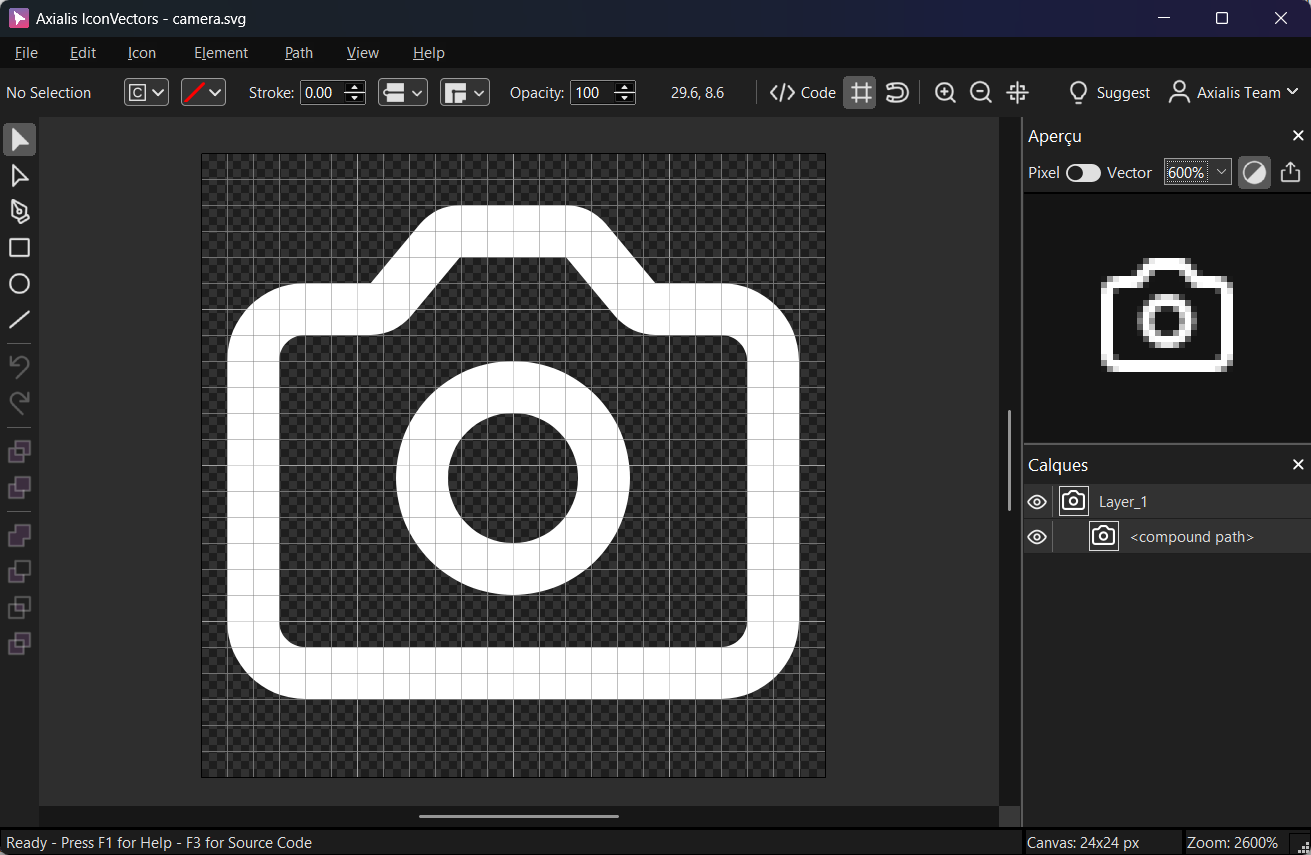
Keep it simple: paths and strokes are fine; avoid filters, masks, and heavy effects. - Flatten & simplify (as needed)
- Remove filters/masks/clipping. Vector Asset Studio imports a subset of SVG.
- If you used complex strokes (dashes, wide outlines), consider converting them to filled paths for predictable results.
- Ensure the root has a clean
viewBox(e.g.,0 0 24 24).
- Export Minified SVG
Choose File → Export → Export Minified (Shift+Ctrl+M) and save
ic_check_24.svg. This strips metadata and preserves the geometry.
Import with Vector Asset Studio (Android Studio)
- Open Vector Asset Studio
- Resource Manager → + → Vector Asset, then pick Local file (SVG) and select your exported SVG.
- Or use File → New → Vector Asset from the Project view.
- Review the preview & name
- Set a descriptive name (e.g.,
ic_check_24) and verify the tint/fill if you rely on a single color. - Fix warnings: simplify gradients, remove unsupported attributes, or re-export with strokes outlined.
- Set a descriptive name (e.g.,
- Finish to generate a VectorDrawable
Android Studio creates
res/drawable/ic_check_24.xml. A minimal VectorDrawable looks like this:<vector xmlns:android="http://schemas.android.com/apk/res/android" android:width="24dp" android:height="24dp" android:viewportWidth="24" android:viewportHeight="24"> <path android:fillColor="#000" android:pathData="M4,12 L9,17 L20,6" android:strokeColor="#000" android:strokeWidth="2" android:fillAlpha="0" /> </vector>
Use the drawable in layouts
- ImageView:
<ImageView android:layout_width="24dp" android:layout_height="24dp" android:src="@drawable/ic_check_24" /> - Tint with theme color (Material):
<ImageView
  android:layout_width="24dp"
  android:layout_height="24dp"
  android:src="@drawable/ic_check_24"
  android:tint="?attr/colorPrimary" />
Optional: PNG fallbacks
- If you support very old devices or specific toolchains, export small PNG sizes from the same SVG via File → Export → Export to Multiple Bitmaps (Shift+F3) and place them under density folders (e.g.,
mipmap-ordrawable-). - Keep the vector as the primary asset; use PNGs only where strictly required.
Adaptive launcher icons
App launcher icons on Android 8.0 (API 26) and up are adaptive: a foreground and a background layer that the launcher can mask into different shapes. A VectorDrawable works as either layer. Each layer is 108x108dp, and the outer edges are used for the mask and motion, so keep the key artwork within the central 66dp-diameter safe zone or it can be clipped. The same safe-zone idea drives web app icons; see PWA maskable icons for the browser equivalent.
Other conversions
Related guides
Start Making SVG Icons Today with IconVectors
Download the fully-functional 30‑Day Free Trial and unlock your icon design workflow.
Version 2.10 for Windows - October 6, 2026. macOS and Linux: version 2.00 available now, 2.10 coming soon.