


A bitmap favicon ships several fixed PNG sizes that still look blurry on high-DPI tabs, and the file set is tedious to keep in sync. This guide replaces that with a single favicon.svg that stays sharp at any density, plus two small PNGs and one favicon.ico as fallbacks — all exported from Axialis IconVectors in two passes, then wired into <head>.
When the SVG favicon is enough, and when to add .ico
- Modern browsers (Chrome 80+, Firefox, Edge, Safari 16.4+) load an SVG favicon from
<link rel="icon" type="image/svg+xml">, so it is your primary icon. - Fallbacks still matter where SVG is ignored — older browsers, RSS readers, some embeds, and OS-level shortcuts. A 16x16/32x32 PNG pair plus a combined
favicon.ico(a few KB total) covers those cases.
Step-by-step in IconVectors
- Open, draw, or import your SVG logo.
- Open: File → Open… (Ctrl+O)
- Create: New Icon (Ctrl+N); prefer a simple silhouette that reads at 16×16.
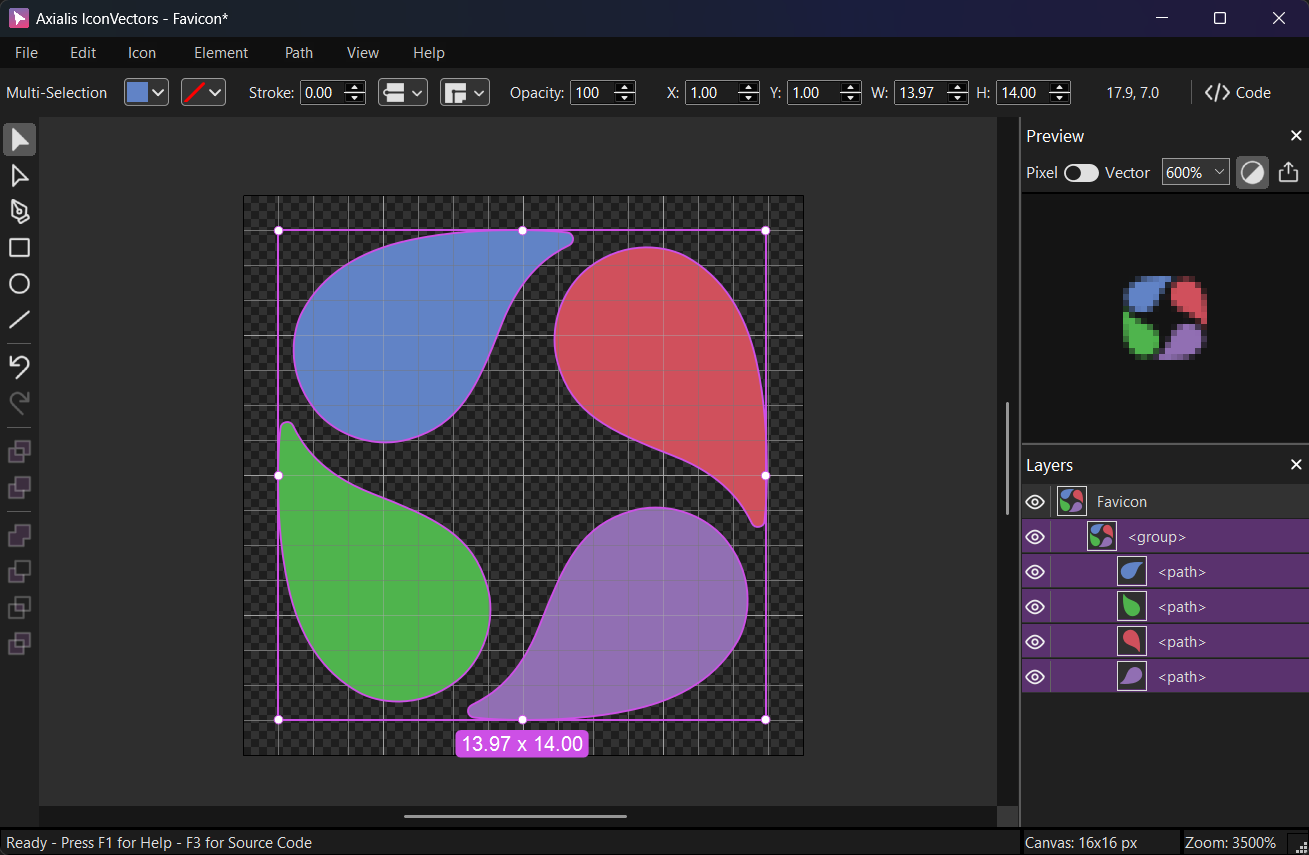
Use a square canvas with a clean viewBox(e.g.,0 0 16 16). Keep details bold for 16×16.For a themable variant, set fills/strokes to
currentColorand inline the SVG where needed. The favicon itself sits outside the document, so it does not inherit page CSS — use the dark-mode swap in step 4 to recolor it. - Export a minified SVG favicon
Choose File → Export → Export Minified (Shift+Ctrl+M) and save as
favicon.svg. This strips metadata/whitespace and preserves theviewBox.<!-- Minimal example (black fill) --> <svg viewBox="0 0 32 32" xmlns="http://www.w3.org/2000/svg"> <path d="M8 8h16v16H8z"/> </svg> - Generate PNG + ICO fallbacks in one pass
Open File → Export → Export to Multiple Bitmaps (Shift+F3):
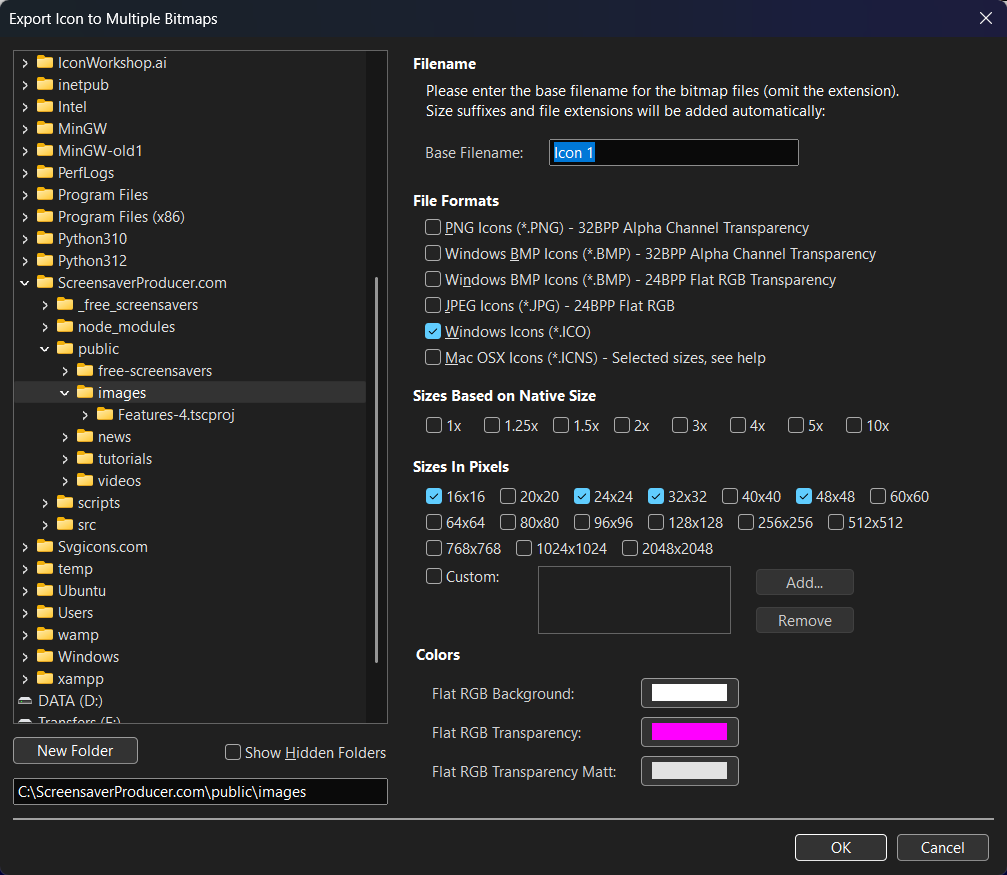
- Destination: choose your
/public/or/static/icons folder. - Base Filename:
favicon. - File Formats: check PNG Icons (*.PNG) and Windows Icons (*.ICO).
- Sizes in Pixels: tick 16 and 32 (optionally 48).
This will create
favicon-16.png,favicon-32.png, and a combinedfavicon.ico. - Destination: choose your
- Wire up modern link tags
Add these to your HTML
<head>:<!-- Primary: SVG favicon --> <link rel="icon" type="image/svg+xml" href="/favicon.svg"> <!-- Minimal PNG fallbacks --> <link rel="icon" type="image/png" sizes="32x32" href="/favicon-32.png"> <link rel="icon" type="image/png" sizes="16x16" href="/favicon-16.png"> <!-- Legacy fallback --> <link rel="shortcut icon" href="/favicon.ico" type="image/x-icon">Optional dark mode swap:
<link rel="icon" type="image/svg+xml" href="/favicon-dark.svg" media="(prefers-color-scheme: dark)"> <link rel="icon" type="image/svg+xml" href="/favicon.svg" media="(prefers-color-scheme: light)"> - Verify in the browser
- Hard-reload and check the tab and address bar. Browsers cache favicons aggressively, so if the icon does not change, clear the cache or open the page in a private window.
- In DevTools, open the Application panel and check the Manifest and Icons sections to confirm which icon the browser picked.
The complete modern set (files and tags)
For full coverage across browsers, iOS home screens, and installable web apps, ship this set. Every file comes from the same IconVectors master: the two passes above, plus one apple-touch-icon and the two manifest sizes.
favicon.svgis the primary icon at any density.favicon.icocovers legacy browsers and OS shortcuts (16/32/48 inside).favicon-16.pngandfavicon-32.pngare the PNG fallbacks.apple-touch-icon.pngis a 180x180 PNG for the iOS home screen (iOS does not use the SVG).icon-192.pngandicon-512.pngfeed the web app manifest and Android install.site.webmanifestdeclares the app name, colors, and the 192/512 icons.
The full <head>:
<link rel="icon" type="image/svg+xml" href="/favicon.svg">
<link rel="icon" type="image/png" sizes="32x32" href="/favicon-32.png">
<link rel="icon" type="image/png" sizes="16x16" href="/favicon-16.png">
<link rel="shortcut icon" href="/favicon.ico">
<link rel="apple-touch-icon" sizes="180x180" href="/apple-touch-icon.png">
<link rel="manifest" href="/site.webmanifest">
<meta name="theme-color" content="#0b1120">
A minimal site.webmanifest:
{
  "name": "Your App",
  "short_name": "App",
  "icons": [
    { "src": "/icon-192.png", "sizes": "192x192", "type": "image/png" },
    { "src": "/icon-512.png", "sizes": "512x512", "type": "image/png", "purpose": "any maskable" }
  ],
  "theme_color": "#0b1120",
  "background_color": "#0b1120",
  "display": "standalone"
}
Generate the 192 and 512 PNGs (and a padded maskable variant) from the same SVG with the PWA maskable icon pack guide, and build the multi-size .ico with Convert SVG to ICO.
Notes & troubleshooting
- Jagged at 16x16? Simplify the shape so strokes land on whole pixels, then export the 16 px PNG and check the raster result before shipping.
- Color looks off in the PNGs? Do not export with a matte; keep the alpha channel intact (32-bpp PNG) so edges stay clean on any background.
- Multiple brands or locales? Swap the
hrefof the SVG<link>per route in your templates or server-side logic, rather than shipping one icon for every brand.
Related guides
Start Making SVG Icons Today with IconVectors
Download the fully-functional 30‑Day Free Trial and unlock your icon design workflow.
Version 2.10 for Windows - October 6, 2026. macOS and Linux: version 2.00 available now, 2.10 coming soon.